Method
Build the tomato base
Heat the oven to 190°C (375°F). Finely chop 150 g of yellow onion and mince 4 garlic cloves. Warm 15 ml of olive oil in a saucepan over medium heat. Add the onion and three quarters of the garlic; cook for 4 to 5 minutes, stirring often, until translucent but not browned. Stir in 2 g of dried oregano, half of 3 g of kosher salt, and half of 1 g of black pepper for 20 seconds. Add 800 g of no-salt-added crushed tomatoes, bring to a gentle simmer, then lower the heat and cook uncovered for 15 minutes, stirring every few minutes. The sauce should mound briefly on a spoon but remain loose enough to flow. Remove from the heat and reserve the remaining garlic.
15:00Cook the noodles
Bring a large pot of water to a rolling boil. Add 220 g of lasagna noodles one at a time and cook for about 2 minutes less than the package directions, stirring carefully during the first minute so the sheets do not stick. Begin checking 2 minutes before the package's stated boil time. The noodles should bend without cracking but still feel slightly firm because they will finish in the oven. Transfer them to a wide bowl of cool water, then lay them flat in a single layer on a clean damp kitchen towel.
Wilt and dry the spinach
Place 150 g of baby spinach in a large skillet over medium heat with the reserved garlic and a small splash of water. Turn the leaves with tongs for 2 to 3 minutes, until fully wilted and bright green. Move the spinach to a fine-mesh sieve and let it cool just enough to handle. Press firmly to remove as much liquid as possible, then chop it finely. The spinach should feel damp but should not release water when squeezed.
03:00Mix the upgraded filling
Add 425 g of whole-milk ricotta cheese, 30 g of parmesan cheese, 30 g of plain breadcrumbs, and 0.3 g of ground nutmeg to a mixing bowl. Chop 10 g of fresh basil. Add the chopped spinach, half of the basil, and the remaining salt and pepper. Reserve the other half of the basil for serving. Reserve one third of 113 g of low-moisture mozzarella cheese for the top, then fold the rest into the ricotta mixture. Stir until the spinach and cheese are evenly distributed. The filling should hold a soft mound on a spoon; when it spreads like a loose sauce, mix in a small extra spoonful of breadcrumbs before rolling.
Build the double-route spirals
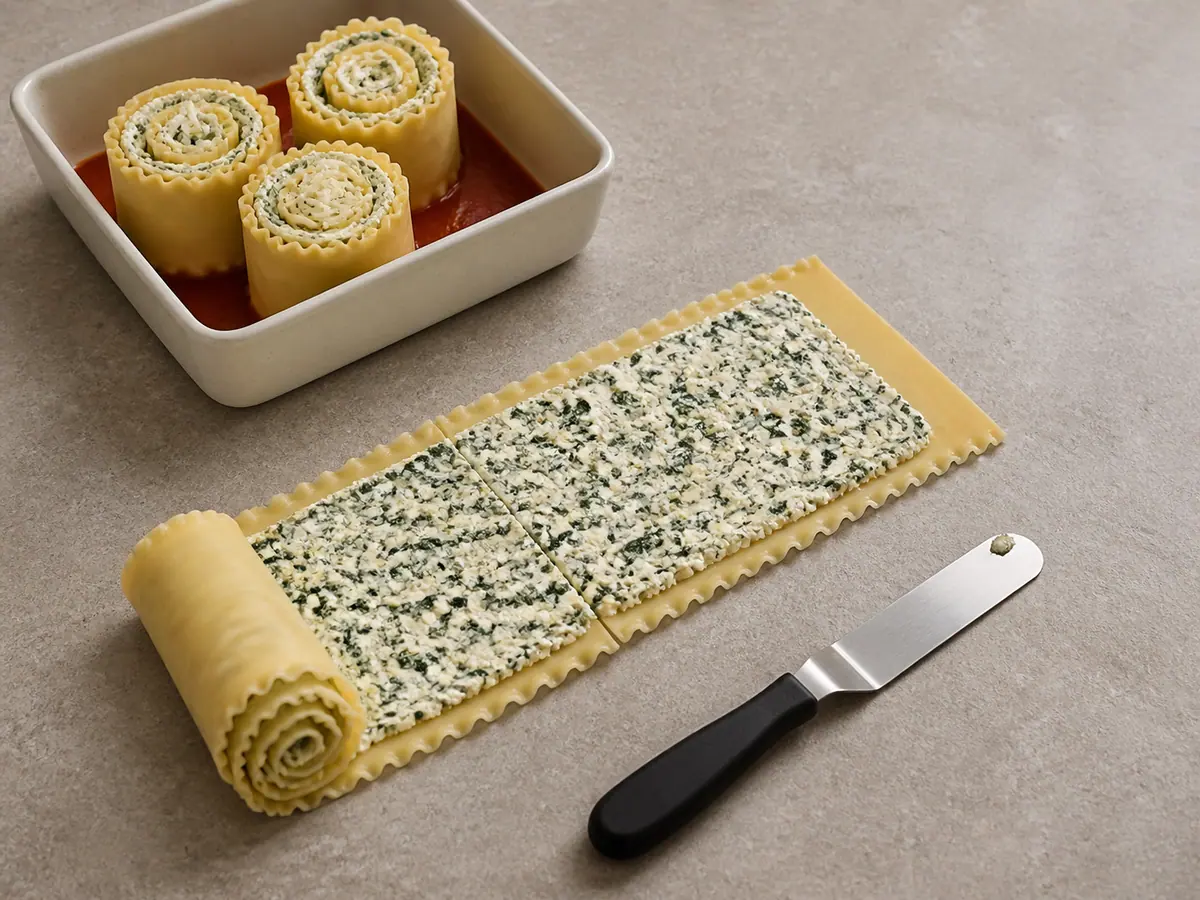
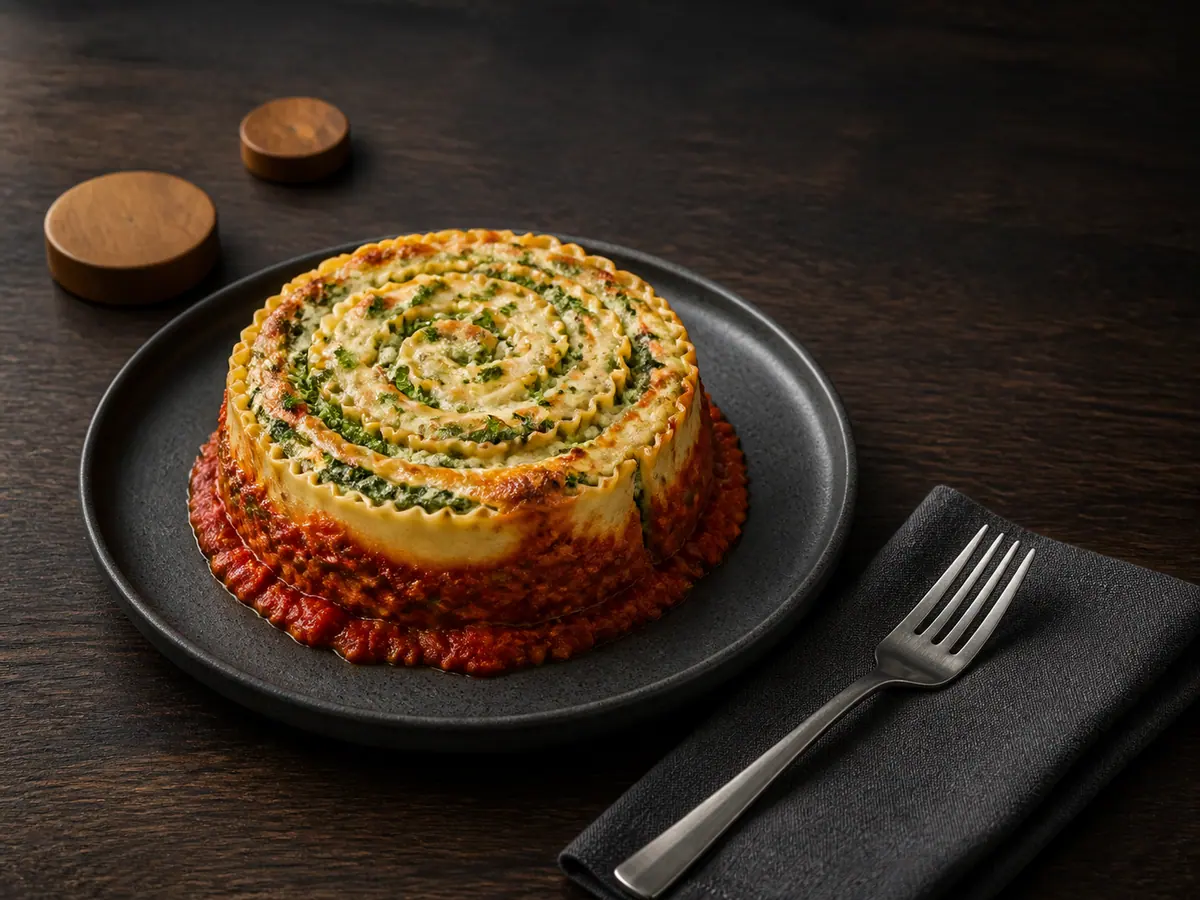
Use a 23 x 23 cm (9 x 9 in) baking dish (for 4 servings). For scaled batches, choose a dish that keeps the spirals snug in one layer at a similar depth. Spread about one third of the tomato sauce across the bottom. Arrange 220 g of lasagna noodles in pairs, two sheets per serving, and overlap each pair by 3 cm (1 1/4 in) to form one long ribbon. Divide the filling evenly among the paired ribbons and spread it about 5 mm (3/16 in) thick, leaving the final 2 cm (3/4 in) bare. Starting at a short end, roll each ribbon into one broad spiral and stand it upright in the dish with the concentric layers facing up. Spoon the remaining sauce around the lower halves without covering the exposed coils, then scatter the reserved mozzarella over the tops.
Bake the spirals under cover
Cover the baking dish loosely with foil, tenting it so the foil does not press against the exposed pasta coils. Bake at 190°C (375°F) for 20 minutes. The sauce should begin bubbling around the edges and the spirals should feel stable when the dish is moved gently.
20:00Brown and verify doneness
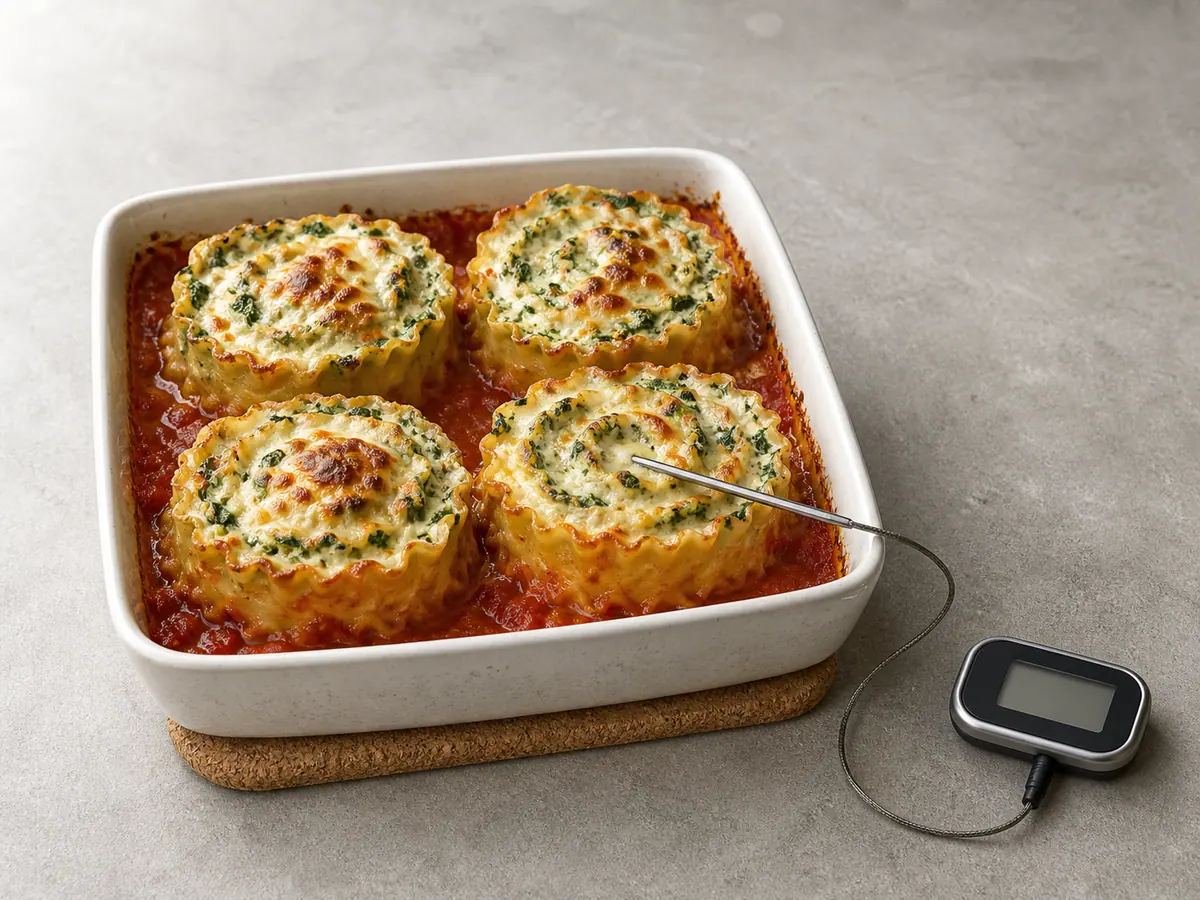
Remove the foil and continue baking for 10 to 15 minutes. Start checking at 10 minutes. The mozzarella should be melted with golden spots, the exposed pasta ridges should be lightly crisp, and the sauce should bubble steadily. Insert a food thermometer into the center of one spiral without touching the dish; continue baking until it reaches 74°C (165°F). If the tops darken before the center is hot, lay the foil loosely over the dish again.
10:00Rest the stacks
Let the dish stand for 10 minutes so the filling firms and the sauce settles. Run a thin spatula around each spiral, lift one stack onto each plate, spoon tomato sauce from the dish around the base, and finish with the reserved basil. Serve immediately while the upper ridges are still crisp.
10:00


Smart Substitutions
- No ricotta? Use well-drained small-curd cottage cheese and pulse it briefly until mostly smooth.
- No spinach? Use finely chopped lacinato kale; cook it until tender, then press out excess moisture.
- No breadcrumbs? Use the same amount of fine semolina or finely crushed plain crackers to keep the filling firm.
- Want a sharper finish? Replace half the mozzarella with provolone and keep the parmesan in the filling.
Tips and Variations
- Use ordinary boilable lasagna noodles; very thin oven-ready sheets tend to crack while rolling.
- Overlap the noodle ends while they are still slightly tacky so the joined ribbon stays aligned.
- Stop the filling short of the far edge so the last turn seals without pushing cheese into the dish.
- Leave the top coils partly exposed above the sauce so they brown and become lightly crisp.
What Went Wrong?
- Spiral stack slumps The noodles may be overcooked or the filling too wet. Cook the sheets only until flexible, press the spinach dry, and keep the stacks snug in the dish.
- Filling squeezes out Spread a thinner layer and leave the final 2 cm (3/4 in) of each ribbon bare before rolling.
- Pasta edges are tough Loosen the tomato sauce with a small splash of water before assembly and keep the lower half of every spiral in contact with sauce.
- Center is not hot Cover the dish loosely and continue baking until a food thermometer reads 74°C (165°F) in the middle of a spiral.
Nutrition Estimate
- Fiber: 8 g per serving
- Sodium: 860 mg per serving
Nutrition disclaimer:This recipe is provided for general cooking information only. Nutrition values are estimates and may vary by ingredients, brands, preparation methods, and serving sizes. Check ingredient labels and follow appropriate food-safety practices. This content is not medical, dietary, allergy, or professional food-safety advice.
FAQ
Found an error or have a suggestion?
Help us improve this recipe. Send us your feedback and include the recipe name so we can take a look.